
Why Is My Faucet Leaking at the Base? Easy Causes & Fixes
It can be pretty difficult to figure out why there is water pooling at the base of a drip-free faucet leaking. You may find yourself wasting time wiping water off only to return minutes later to see puddles appear again. Faucet leaks are caused by worn internal components and/or loose connections.
This sort of leak should be addressed sooner rather than later because it can cause water damage to your cabinets, counters, and other adjacent fixtures. Fortunately, most base leaks are pretty simple to address and can be identified before they become larger plumbing issues.
What Could Possibly Cause a Faucet Leaking at the Base?
The reason behind the leak could depend on several common factors.
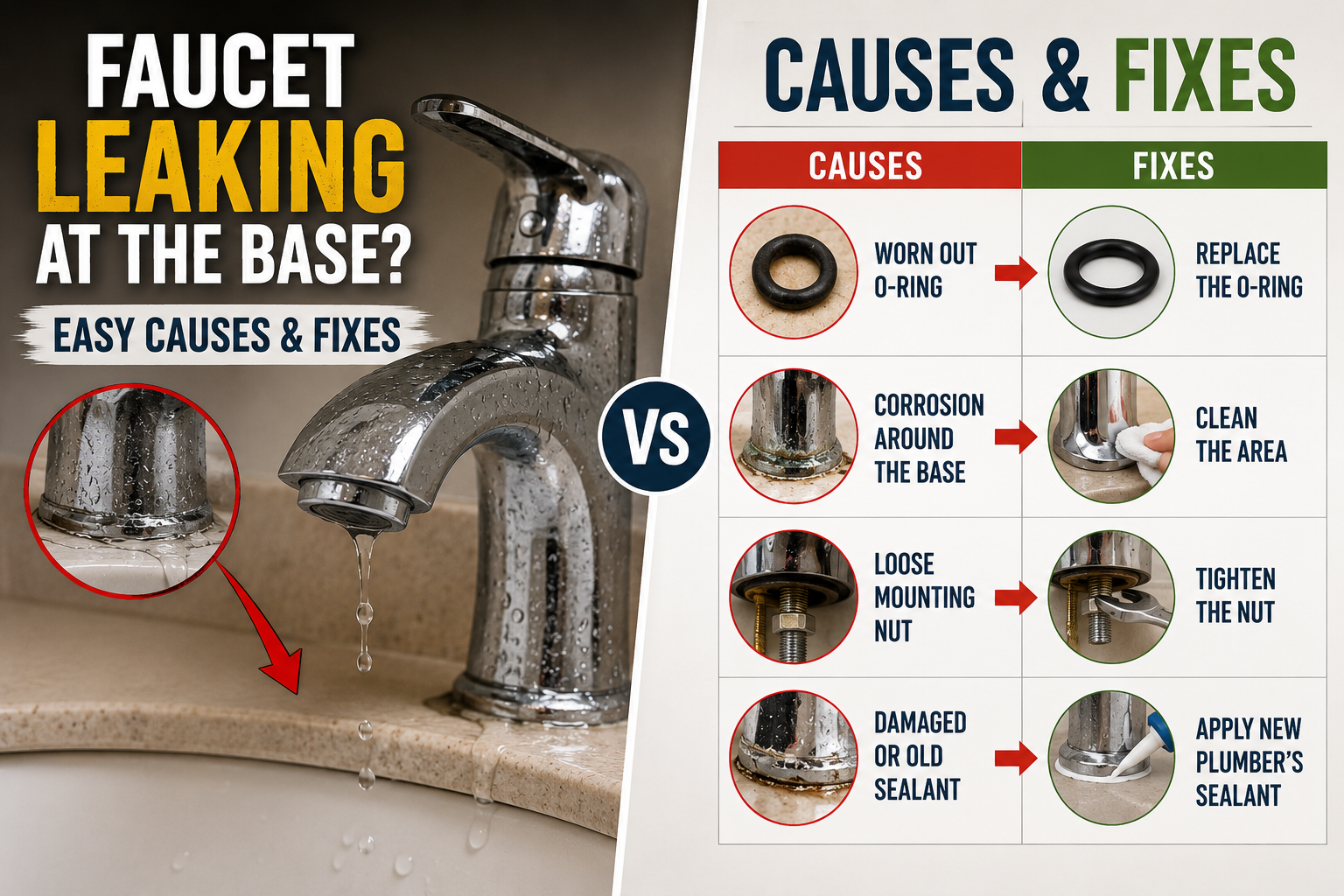
O-Rings and Washers
There are rubber seals installed on a lot of faucets to prevent water from leaking past the seals. Sometimes these can dry out, get cracked, get brittle, or get worn out. Once these seals get worn, water can stream from the faucet leaking and puddle at the base. If there is a leak due to a worn O-ring or washer, a new O-ring and washer usually will correct the issue.
Loose Connections
Faucets are connected to supply lines with various fittings or hoses. If a fitting loosens, water can leak out and pool.
Watch for moisture accumulation in the following places around the sink:
- Supply lines
- Faucet brackets
- Connectors and joiners
- Connections on supply lines
Beware of overly tightening connectors and joiners because too much tightening can result in connections becoming deformed, compromising seals.
There are areas on faucets that also tend to accumulate minerals due to hard water. The accumulation can affect the functionality of the faucet and prevent seals from closing.
The buildup can also make it difficult to determine where the water is coming from. Clean the area and remove the accumulation to assist in identifying the source.
How Can You Tell Where the Faucet Leak Is Coming From?
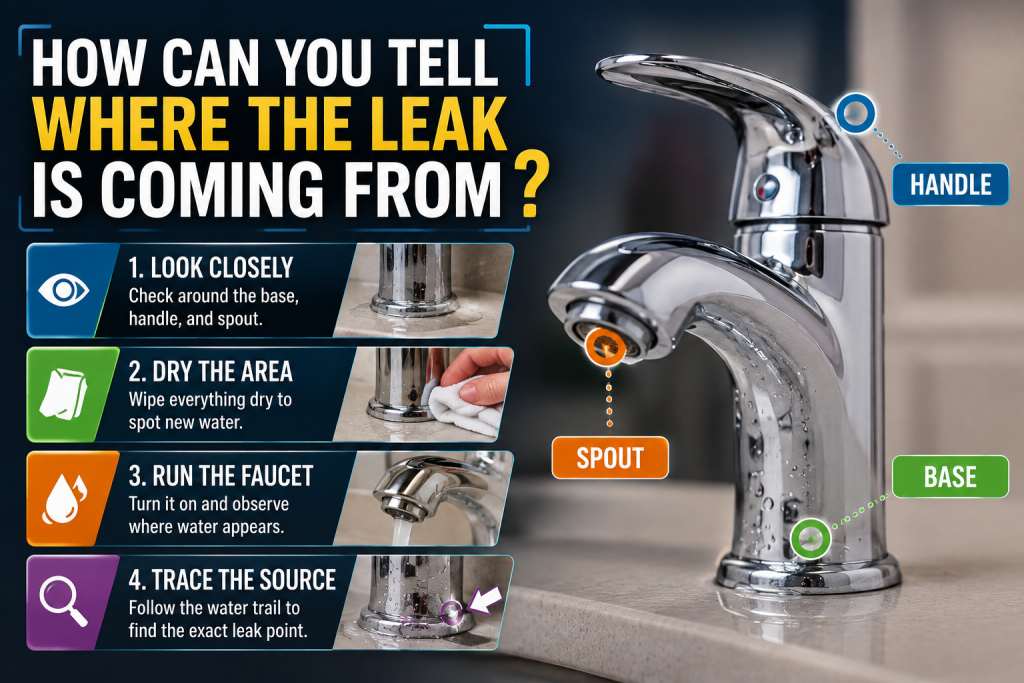
To help identify the source of the faucet leaking, turn off the faucet and let the area under the sink dry. Then turn the faucet on to see if you can identify the source.
Check the Faucet While It Runs
When you turn on the water, look around the base and see if water is coming from the base. Look to see if water is coming from the base when you move the handle, rotate the spout, or even turn on the water. A faucet with a single handle may leak around the cartridge or seals.
If you see water coming from the base and the faucet is running, the problem is probably with an internal part or the faucet body.
Inspect the Area Under the Sink
It is possible a leak is coming from a connection underneath the sink and not from the faucet itself.
Use the flashlight to see:
- Supply hoses
- Shutoff valves
- Connectors
- The faucet and the water line connection
Even if a wet supply line is visible, the problem may be beyond just replacing a seal and may require plumbing on the faucet.
How to Fix a Leaky Faucet
Most minor faucet leaking can be fixed on your own. Before removing any components of the faucet, make sure you shut off the water supply.
How to Replace a Faucet Seal
In most cases, you will be able to remove the handle and cartridge to replace the damaged seal.
Faucet Repair Instructions
To complete the repairs, follow the instructions listed below.
1. Close both of the water supply valves.
2. Open the faucet to release pressure.
3. Take out the faucet handle/component.
4. Evaluate the washer, cartridge, and O-ring.
5. Remove the faulty washer, cartridge, and O-ring.
6. Put the faucet back together.
7. Slowly open the water supply back up to the faucet.
8. Check the faucet for leaks.
If the faucet continues to leak after replacement, likely another internal faucet component has also been affected.
How to Fix a Leaky Faucet
In most cases, a loose connection can be fixed by a slight readjustment. Never try to force a connection. You should never attempt to pry a leak closed, as this will cause the leak to get worse.
If you experience water or faucet leaking after tightening the connections, it is likely that you will need a professional faucet repair.
When to Seek Professional Help
Call for faucet repair when:
- Your seal replacement does not stop the leak.
- You see interior cabinet water leakage.
- The faucet body is cracked or sagging.
- The shutoff valve is leaking.
- Water is leaking from multiple fixtures.
- You are unable to determine the source of water leakage.
A plumber can either fix the faucet alone or determine if there is an issue in the main water line or even the plumbing.
Along those lines, most faucet leaking have no relation to sewer line issues. Sewer line problems tend to be more noticeable with drainage, wastewater, smells, and backups of water and are rarely related to clean water collecting next to a faucet.
Faucet Maintenance Tips
Leaks can be costly, but with some simple maintenance, you can avoid them.
- Keep Connections and the Sink Area Dry
- Avoid Excessive Force
- Watch for Changes in Water Pressure
Benefits of Hiring JD’s Drain Cleaning for Faucet Problems?
JD’s Drain Cleaning provides various plumbing and drain services for complicated problems that go beyond a low-level drip. An untreated leaking faucet can cause water damage, so identifying the cause is essential to limit further damage.

JD’s Drain Cleaning evaluates the faucet as well as the surrounding connections to see if a repair or replacement is needed on the plumbing or if the issue is with the connected water line. Homeowners will no longer have to treat the symptoms of the problem repeatedly.
Stop The Drip Before It Becomes A Bigger Problem
Even a minor leak can create a major problem if left unaddressed. Affected materials can wear out, and the continual flow of water can loosen the connections. Once the leakage location is known, the connections should be checked for seals, and a shutoff is required to check if the leakage is due to a loose connection.
A faucet leaking, even if small, should be addressed as it can damage the adjacent surfaces. Early detection and repair of leaks can save time and money by avoiding the replacement of a water-damaged surface and its connections.
Common Questions About a Leaking Faucet
1. Why does my faucet leak only when I turn it on?
A leaking faucet that only occurs when the faucet is turned on could be caused by several things, including internal seal failure, damage to the cartridge, or leakage around the body of the faucet.
2. Can a loose faucet cause water to leak at the base?
A loose faucet can create a leak at the base. A loose faucet leaking can damage the seal of the faucet due to the faucet being able to move around. To stop the leak, the mounting hardware will need to be tightened.
3. Is a faucet leak a plumbing emergency?
A leaking faucet is not always considered an emergency. However, a rapid leak, water entry in the cabinets, or an uncontrolled supply line leak are all emergencies.
4. Is it necessary to replace the entire faucet if it is leaking?
Not necessarily. Many leaks can be addressed by replacing a washer, O-ring, cartridge, etc. Consider replacement if the faucet is heavily corroded or cracked, or if it fails repeatedly.
5. Why is the faucet that I just purchased leaking?
Several issues can result in leakage and can even be a result of a bad installation. Look for the cause in the manuals provided by the manufacturer and inspect the connections to rule out a defective faucet leaking.